
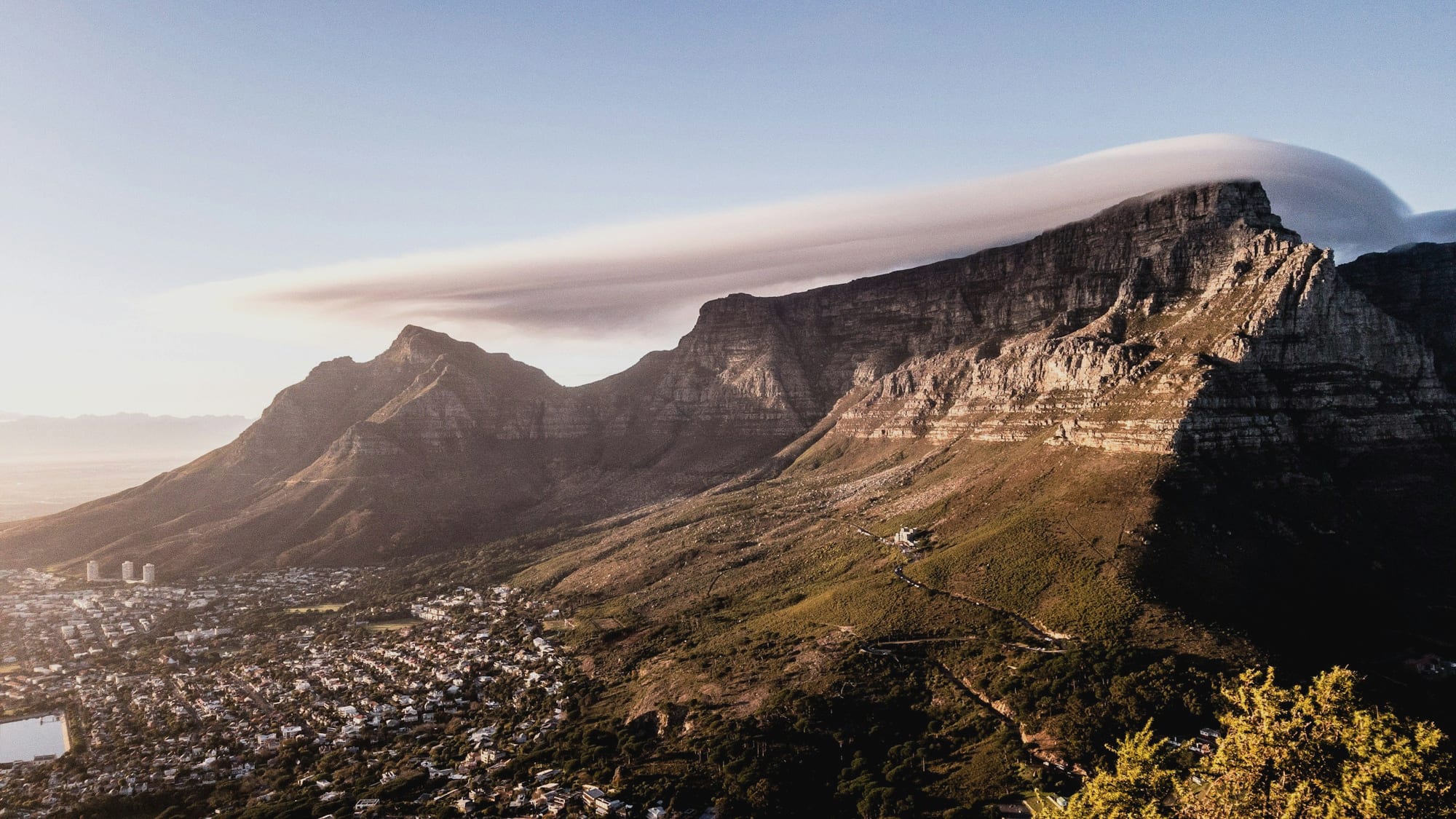
The southern light, at the foot of the continent.
A flat-topped mountain stands straight up out of the city, and the city falls away to a coast where the cold Atlantic current runs into the warm water coming round from the east. Cape Town is a small, steep place where everything sits close together, the City Bowl, the Atlantic Seaboard, the working harbour, the vineyards half an hour inland. It rewards knowing where to stand, and at what hour.
The route itself is unusual. From London it is one flight, roughly eleven hours and a half, flown overnight and almost due south, so you land with only an hour or two of time to make up and a whole first day of the Cape still in front of you.
Why Our Clients Go
Our clients come for the setting and stay for the table. Cape Town has become one of the best eating cities in the southern hemisphere, and the finest of it, the chef's tables and the estates that pour only for people they already know, sits behind doors with no public number. The Winelands, thirty to fifty minutes out, are where the serious afternoons happen: Constantia closest to the city, Stellenbosch and Franschhoek beyond.
We know the city by hour and by wind. The southeaster the locals call the Cape Doctor decides which beach, which terrace and which side of the mountain on any given afternoon, and it is the difference between a flat calm at Clifton and a gale on the cableway. We know which houses hold the morning light and which hold the evening sea, and we book accordingly.
And we know the people. A nine-room house on Bantry Bay that keeps a room for us. A skipper in Hermanus when the whales are in. A table at the estate restaurant that was full a month ago. When something needs holding, it is held with one phone call. We answer within twelve hours.
How We Arrange It
- 01From London the aircraft goes direct and overnight, British Airways' Club Suite or Virgin Atlantic's Upper Class, one leg, roughly eleven hours and a half, landing in time for breakfast. There is no first cabin on the direct; when a client wants one, we route through the Gulf, Emirates First through Dubai or Qatar's Qsuite through Doha, and time the connection so the long leg is the one spent asleep.
- 02For the address, the houses other people cannot get into: Ellerman House on Bantry Bay, nine rooms above the Atlantic with a private collection of South African art on the walls, or the Silo at the Waterfront, set above the Zeitz museum behind its pillowed-glass windows with a pool on the roof. In the Winelands, La Residence at Franschhoek or Delaire Graff below the Stellenbosch mountains.
- 03The airport is twenty minutes from the Waterfront. A car and an English-speaking driver meet the aircraft, and airside assistance clears you through before the cabin has emptied.
- 04A helicopter when the ground is too slow, over Cape Point and the Twelve Apostles, or straight into the Winelands for lunch and back before the afternoon wind gets up.
- 05The details are where we earn our keep: a table held at La Colombe in the Constantia woods, a tasting at an estate that pours for no one off the street, Table Mountain at first light before the cableway turns and the crowd arrives, a private skiff off Hermanus when the whales have come in.
When To Go
November to February
High summer, and the reason most people picture the place: long days, warm rock, the Atlantic beaches at Clifton and Camps Bay at their best. It is also the busy stretch and the windy one, the southeaster blows hardest now, so the right address on the sheltered side matters more than at any other time of year.
March to May
The quiet window that people who know the Cape keep to themselves. The wind drops, the crowds thin, the sea holds its summer warmth, and the Winelands come into harvest with the estates at their most alive. Autumn is the Cape at its best and least crowded.
June to October
The green Cape, and whale season. Southern right whales come inshore to calve along the coast at Hermanus and in False Bay from around June, close enough to watch from a terrace. Cooler and more dramatic, with far fewer people about, and toward the end the wildflowers of Namaqualand open, in a good year, for two or three weeks only.