
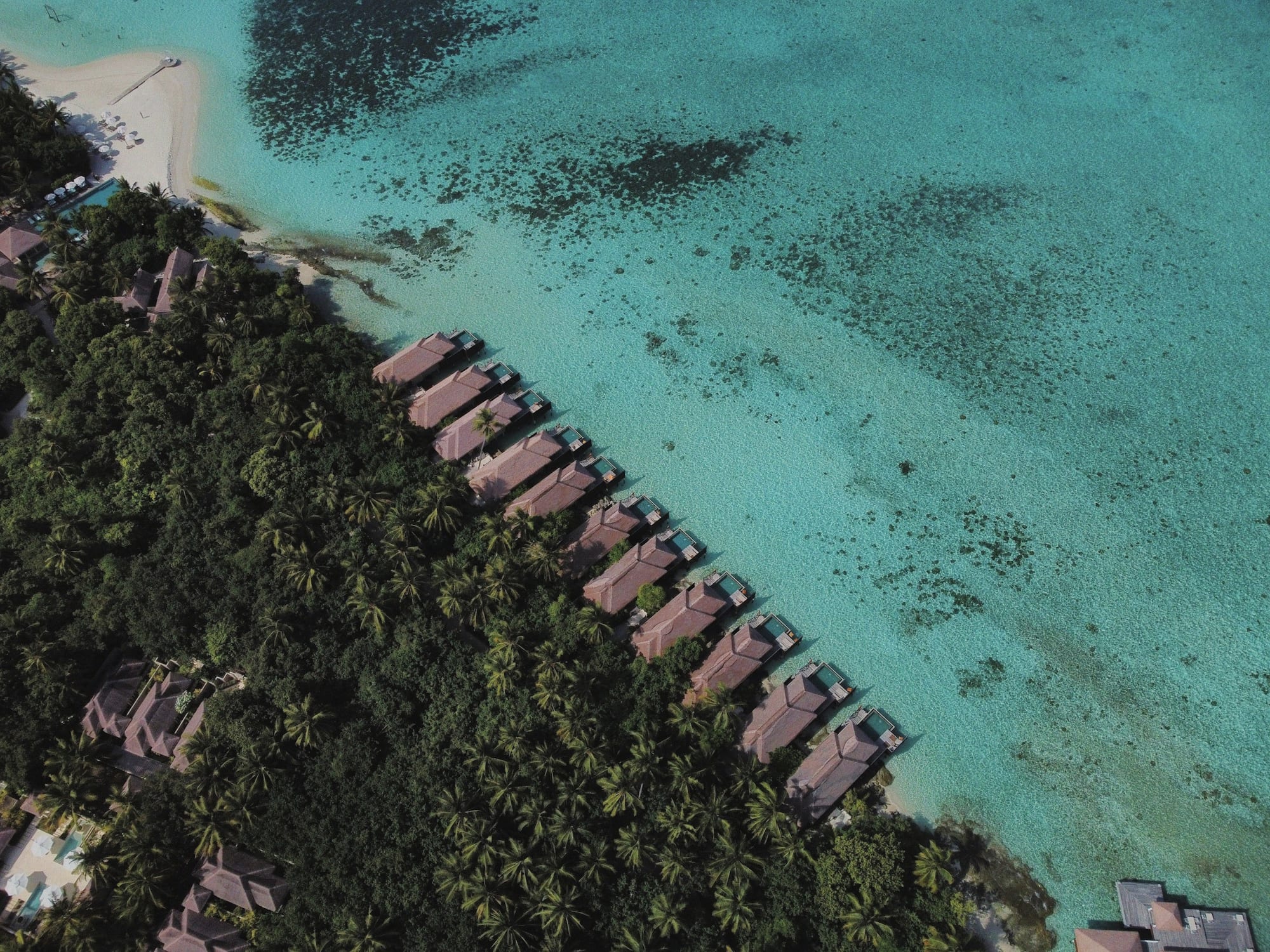
A house on the water, and the ocean for a garden.
The Maldives is a scatter of coral atolls strung along the equator, twenty-six of them, each a ring of low islands around a lagoon. From the air it reads as blue on blue. From a villa at the end of a jetty it is quieter than that, and far more private.
Most of our clients come for one thing that is hard to arrange elsewhere: water on every side, a reef a few steps down, and no one they did not choose to see. The islands are small. The good ones are held by a single resort, and the distance between them is measured in seaplane minutes.
Why Our Clients Go
The appeal is specific. A villa built over the lagoon, a private pool facing the weather, a house reef you reach without a boat, and a horizon with nothing on it. The arrival is part of it — a seaplane banking low over the atolls, then a jetty, then quiet.
The island is the entire decision, and the islands are not alike. House reefs run from ordinary to remarkable, and only a handful are worth planning a trip around. A villa on the sunrise side wakes differently from one on the sunset side. Seaplanes fly in daylight only, so a late arrival into Malé means a night in the city before the last leg, and we would rather move the flights than lose you a day. Some resorts welcome children and build for them; others are adults-only and silent by design. We know which is which, and we place people accordingly.
What we hold is access to the best of each island — the two- and three-bedroom residences with their own chef and staff, the water villas at the far, unbroken end of the jetty, the reserves that sit alone on a private reef. Several islands keep a resident marine biologist and run a dawn drop to the manta channels; we arrange that before you land. One contact throughout. We answer within twelve hours.
How We Arrange It
- 01From London, Qatar Airways Qsuite through Doha, Emirates First with the shower suite through Dubai, or Etihad First Apartments through Abu Dhabi — all into Velana International at Malé, the single gateway. From Asia, Singapore Airlines Suites through Changi. First or business throughout, and you land fresh.
- 02An overwater villa with a private pool as standard; a beach villa where a family wants sand at the door; a two- or three-bedroom residence with its own chef and butler for a larger group. We choose the villa by reef and by aspect, not by number.
- 03The transfer is chosen to the island. A speedboat for the near atolls around Malé, a Trans Maldivian seaplane for the middle distance, a domestic flight and a launch for the far south. We time the seaplane against your inbound flight and hold the private lounge at Velana so the connection stays short.
- 04A sandbank lunch laid for two on an island that appears at low tide and is gone by evening. A dawn drop at Hanifaru with a marine guide before the day-boats arrive. Dinner cooked on your own deck. Small things, settled before you arrive.
- 05Where a flight lands too late for the daylight seaplane, a suite at the one hotel worth using by the airport and the first departure at first light. The airport queue is not your problem.
When To Go
December to April
The dry season, and the reason most people picture the place — calm, glassy water, low humidity, long settled days. Christmas and the New Year fill a year ahead, and we hold those villas early.
May to July
The southwest monsoon opens. Rain comes in warm, short bursts rather than grey days, the crowds thin, and the plankton arrives — with it the manta rays gather at Hanifaru Bay in Baa Atoll. The strongest snorkelling and diving of the year begins here.
August to November
Still the green season: warm water, fewer boats on the reef. The mantas hold in the channels and whale sharks pass through, best around the new and full moon. By November the weather settles back toward the dry.